Despite having studied Latin and Greek for years, I always find
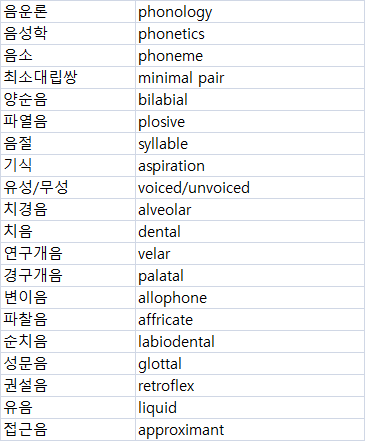
linguistic terminology, which is mostly derived from Classical languages, really hard to understand. Bizarrely, seeing the Korean version, which is derived from Chinese, actually helps understand the English!
Honestly, the most important thing in your target language isn’t to memorize all the vocabulary or grammar bits.
It’s the ability to describe and talk your way around words you don’t know because 95% of the time you can’t pull out a dictionary mid-conversation.
I literally use this in nearly every conversation I have in my non-native languages, but particularly in French. It was totally indispensable when I first moved to France 5.5 months ago, but it’s still something I do nearly every day.
Sometimes it’s just rephrasing slightly when you don’t have the right word and sometimes it’s launching into a longish, semi-convoluted explanation of a concept or object.
It seems really hard at first because sometimes you don’t feel as if you don’t even have the words for THAT, but remember that the most important thing isn’t always using the perfect words or perfect grammar—the most important thing is getting your meaning across. And sometimes you’ll have to create odd sentences to explain what you’d normally be able to say in a single word in your native language, and that’s totally okay and it’s honestly a super important skill to work on.
For me, even when I don’t have the right word, if I can still get my meaning across without a real problem (and sometimes learn the word I was aiming for!), then I still feel more confident in my language skills and speaking doesn’t feel so scary.
Even if you’re alone and you don’t have anyone to converse with, you can start by just describing random things around you without using the actual word. Definitely my #1 most used language skill.
this is called circumlocution btw. 10/10 would recommend.
I do this all the time and also my non-English speaking friends have to do this with me all the time as well!
Even if I’m talking with someone who does English, if I am committing to practicing Korean during that conversation, I will just keep speaking Korean until the other person understands rather than switch to saying the much shorter word/phrase in English.
Just got done reading an interesting article about how language affects the way we think and perceive the world. There were some interesting examples. Like how in Spanish, the word bridge is masculine, while in German, it is feminine. So native speakers of these languages describe the same thing differently. Spanish speakers will comment on how strong or sturdy a bridge is, while German speakers will comment on how elegant or beautiful it is. Another example that blew my mind was the Guugu Yimithirr language. So, most languages, including English, use an egocentric type of directional language (turn right, left, behind, in front.) these directions are relative to you as a person. Well, the Guugu Yimithirr language uses fixed geographical directions (North, East, South, and West) no matter the context. If you were to put an English speaker and a Guugu Yimithirr speaker in the same hotel, and put them in rooms opposite sides of the hallway from each other, the English speaker will see the exact same room (that person will see the desk to the right of blah and the closet in front of blah) but the Guugu Yimithirr speaker will see a COMPLETELY different room because the bed will be facing south instead of north, and all of that jazz. And the article went on to state how speakers of this language might even have a lower sense of egotism, because directions do not revolve around them, they’re just another part of the picture. Really fascinating. It made me think really long about language imperialism and how rapidly we’re moving towards a world that deals almost exclusively in English. It makes me sad to know that we’re losing completely different ways of thinking. Completely different perspectives, just gone. I guess that’s why I always get upset when people say that language imperialism isn’t so bad, and that English as a language is connecting people together. The world is a great big place, with completely different perspectives, and I think the fastest way to kill a culture is to take away the language, because not only are you taking away a method of communication, but a way of thinking.



 Sutdy-Korean