Back with more 한자 for you! This time we’ll look at the characters associated with different countries’ names. These characters are often used on the news and in newspapers to unambiguously reference those specific countries. Of course, this varies from station to station and paper to paper. Some news stations and newspapers make more extensive usage of 한자 than others, so depending on what you’re watching or reading, you might see a lot of 한자, or you might not see many at all! For example, the 한겨레 newspaper entirely rejects the usage of 한자, and it also limits it usage of loanwords and the Roman alphabet. It was also Korea’s first newspaper to be printed horizontally instead of vertically!
Two other newspapers with wide circulation in Korea are the 동아일보 and the 조선일보. Both of them use 한자, but the 조선일보 does so more extensively than the 동아일보.
Anyway, let’s dive into some of the country 漢字 most commonly seen on the news and in newspapers. You can find stroke order diagrams for each character at the bottom of the post.
한국/나라 한 韓
Of course, we’ll start with the character that stands for South Korea! This character is 한국 (Korea) 한. Pretty special that it gets its own character! But here’s a little fun fact about this character—it also refers to one of the ancient Chinese states during the Warring States period!
아름다울 미 美
This character is 아름다울 (beautiful) 미 美, and it is used to refer to America, 미국. Oh beautiful for spacious skies, for amber waves of grain~ This one comes from Chinese transliteration. In Chinese, 美國 is read “Mei3guo2,” with the “Mei” sounding a bit similar to the second syllable of “America.” For the sake of good international relations, they chose a character with a pleasant meaning 🙂
날 일 日
We learned this character in the last [ 漢字 배우자! ]. This 漢字, which means “day,” is also used for Japan, or 일본 日本. This comes from Japan being one of the first countries to see the sun rise each day (ever heard someone refer to Japan as “land of the rising sun”?). The second character in 日本 is 근본 (origin) 본 本, so the name 일본 literally means “origin of the day” or “origin of the sun.”
북녘 북 北
북녘 (north) 북 北 is the character used in reference to North Korea, 북한 北韓. It’s pretty self-explanatory.
가우데 중 中
This character means “center” and is used for China, 중국 中國. I had to look this up to make sure I’m not giving you bad information. An answer to a question on Quora about why China calls itself 中國 said, “It referred during the Eastern Zhou/Spring & Autumn period/Warring States period (771 BC to 221 BC) to the powerful central fiefdoms-cum-states of the North China Plain surrounding the Zhou.” There’s a lot more information provided by others on that thread, so please do check it out!
홀로 독 獨
홀로 (alone) 독 獨 is the character used for Germany, 독일
獨逸. This is one that comes from Japanese transliteration. Germans aren’t really lonely… at least I hope not!
꽃부리 영 英
Finally, we have 꽃부리 (corolla [petals]) 영 英. This character is used to represent England 영국 英國. Again, this one comes from Chinese transliteration, with the Chinese reading of 英, Ying1, being similar in pronunciation to the “Eng” of “England.”
BONUS:
로시아: 이슬 로(노) 露
This character used to be used for Russia, but not any longer. 로시아 is a transliteration of the name “Russia,” and the character 이슬 (dew) 로 is the first character of that transliteration. Now, it’s far more common to see (and hear) 러시아.
Of course, these are not the only country 漢字, but this post would get incredibly long if I wrote all them out. For a more extensive list, you can click here! A little fun fact about these 漢字 names is that most of them came from Chinese or Japanese. The Japanese and Chinese people would hear the name of the country in its original language and then approximate it to fit their own pronunciation patterns. Those transliterations then made it to Korea, where they were passed through the filter of yet another language.
These are for Android, but I’m sure you can find similar apps for iOS too.
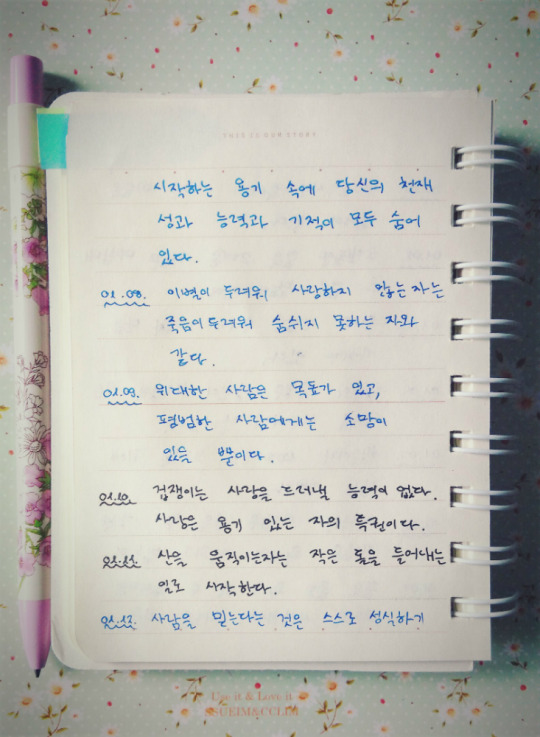
좋은글모음Play Store link This one gives you a 명언 ‘wise saying’ everyday. It also has a widget function so you don’t have to open it everyday. I write down each day’s saying in my notebook. The app’s interface is clean and really pretty. Search for ‘명언’ or ‘
좋은 글’ to find similar apps!
마시멜로 이야기 Play Store You can set a 목표 ‘goal’ and everytime you complete it, it gives you a marshmallow. Or more, because you can set the number of marshmallows you’ll receive for completed goals. You can set more goals, due dates…and it also has a widget function, which asks you if you completed the goal for today, if yes then you receive marshmallows! If not, they take the same amount of marshmallows you would have received. 😦 Search for ‘
목표달성’ or ‘
습관 만들기’ to find similar apps!
씀 Play Store This one gives you two titles a day, and you can write you thoughts about it. You can check the previous titles too. This is great if you would like to write but you have no idea what to write about. You can read other’s writing too. This app’s interface is really clean, but if you want to read other’s writings you have to wait since it tends to be a bit slow.
띄어쓰기 means ‘spacing words‘. You have to learn how to properly space words when writing Korean. You can learn&play at the same time with this app. It gives you a sentence with two words highlighted. You have to decide whether they belong together or they need a space between them. Then it shows whether your answer is right or wrong, then the full sentence written correctly, and an explanation in Korean. It saves your answers so you can go back and check what you did wrong. Check this app’sdeveloper, they have some nice apps! You can find similar apps if you search for ‘
띄어쓰기
‘. Also search for ‘
맞춤법’ which means orthography, the rules of spelling!




 Sutdy-Korean